Wednesday, October 10, 2007

An Underwater Adventure - Darker Things Beckon


Scarlet and I are currently on a ship in the Indian Ocean, near to Enggano -- a small island to the southeast of Sumatra.

My friend The Oceanographer (as I shall refer to him) made good on the debt he owed me -- first transporting us by helicopter to his home base in Japan, and then by sea plane to his "science yacht" stationed off the coast of Java. Our journey, I'm happy to say, was much more comfortable than our previous flight -- from Brussels to Namp'o, squeezed between boxes in the belly of a cargo plane.

The Oceanographer has capitalized on the genre of celebrity scientists (pioneered by personalities such as Jacques Cousteau and Steve Irwin). He is exceptionally well funded, quietly receiving financial support from almost a dozen individuals in the multi-millionaire tax-bracket.

So, you understand, he could afford to be generous when he consented to lend me a small submarine. After all, he had another two on board, simply as spares.

***


Two months ago, rumors reached me about a colony of Porpische living in the deep water trenches off the coast of Sumatra. Obviously I had to investigate. Finding myself reconnecting with The Oceanographer, I knew my chance had arrived.

Scarlet stayed onboard the yacht while I piloted the little yellow sub into the depths. Down, down I dove, until the sheer volume of water above me blocked out all light.

For hours I waited at the mouth of the trench, watching for some sign of life... And then there they were! Rising rapidly on an updraft of hot water from the volcanic vents below, a school of thirty-odd Porpische came into view.

What an amazing sight it was: the twelve-foot-long animals glowing pink, shooting upward as a group. Reaching the top of the trench, they scattered outward into the cooler water. Several took an interest in my sub, and came up close to the viewport. I set the Bolex running, and captured the entire encounter on film.

Then, after perhaps 30 minutes, the school began circling. Like a great spinning candelabra, they descended into the pit again. I was left above, breathless, stunned by the beauty of what I had seen.

***


Risks must be taken in order to advance science. Rousing myself from my reverie, I decided I must try to follow the Porpische down farther into their realm. I believe I descended another mile into the inky depths -- before the incident.

It felt like sky-diving, falling into darkness, just behind the school... When suddenly something enormous smashed past the sub. Immediately I knew I was in trouble: tiny droplets of water began to emerge from one of the welded seams in the submersible's wall. Below me, I saw three of the Porpische wink out in an instant, as a mysterious leviathan swallowed them in a single gulp.

I could not tell what the thing was. I only could see its silhouette for a moment... But from what I so briefly saw, I'd say it was at least three times as long as a Blue Whale -- which would make the thing around 300 feet in length.

The rest of the Porpische, in a fight-or-flight reaction, winked out their lights as they darted toward the invisible column of hot water rising from volcanic vents far below.

Myself, I was taking on water -- and the engine was stalled. I was critically damaged, and sinking fast.

***


What happened next I cannot fully explain. Despite the imminent threat of being swallowed by the leviathan, several of the darkened Porpische raced back to my sub, and together pushed me into the updraft.

Thus, this strange group of etremophile fish saved my life! They spread their wings to catch the upward current, and helped steer my vessel up, up, and beyond the mouth of the trench.

There, they helped push me off to the side, where the sub settled onto the ocean floor. And then, just as had happened before, I watched them regroup, circle, and descend back down toward their home.

Why did they help me? There are many tales of dolphins helping shipwrecked sailors to shore... But this act of bravery, the animals coming back to save me despite an immediate threat to their own lives -- it's an act of inter-species altruism unlike anything I've heard of before.

This, my friends, is one more example -- a gleaming and hopeful example -- of why I have committed my life to finding and protecting the amazing creatures with whom we share this Earth.

***


With no small amount of luck, I was able to get the submarine's motor going again, and I desperately began my ascent toward the surface.

It is a very good thing that I was wearing a pressure suit during this entire ordeal -- because by the time I reached the safety of the waiting yacht, there wasn't more than 18 inches of air left in the sub.

The entire journey back, I had one hand on the submarine's controls -- and one on the Bolex, holding the camera tightly against the sub's ceiling. It appears that I managed to return it intact. ...Success!

The Oceanographer was, shall we say, unhappy about the state of his sub. However, after hearing my tale -- and sharing more than a few glasses of fine cognac -- I feel it's safe to say that all is forgiven and forgotten.

Already another expedition is beginning to take shape... But I will certainly have to return here at a later date. Better equipped, I must go into the abyss again to see if I can discover the nature of that giant silhouette.

The Porpische I encountered were almost like aquatic angels.

Darker things still beckon.

Tuesday, October 9, 2007

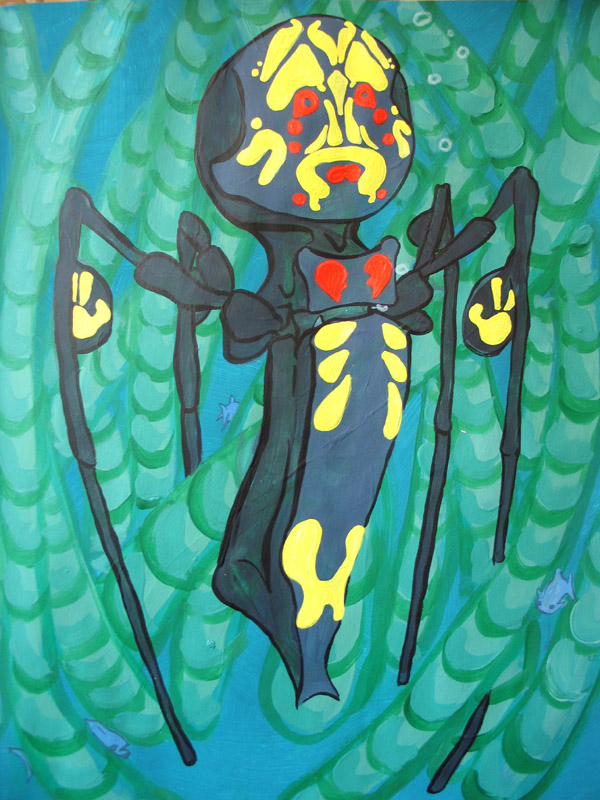
H - The Heartbreak Spider


[click to enlarge]


Bright markings on a creature are often nature's way of saying "danger!" Nowhere is this more true than with Indonesia's Heartbreak Spider.

This four-foot-tall aquatic spider is adorned with brilliant yellow and red markings, which bear an uncanny resemblance to a scared human child:
  • The spider's proportionally-small and raised abdomen simulates the child's head. Many see weeping eyes and a face in the pattern of the abdomen's markings.

  • The cephalothorax lacks pedipalps; instead, there is an exceptionally long and toothy jaw. Markings on the jaw are often interpreted as a human ribcage and pelvis.

  • Also unlike most spiders, this specimen has only four legs -- each of which sports a flexible air bladder, with markings on the front two that look quite like hands.

  • Adorning the creature's "nose" are two more red markings, which look just like a broken heart.

Heartbreak Spiders consume fish and waterfowl -- but they are particularly suited to snaring human prey. Around twilight, when visibility is poor, the creature comes up from its underwater nest, and lurks half-submerged in the shallows of a slow-moving river...

When a human passes by, the spider goes into spasms, splashing about -- which in the half-dark causes it to look very much like a drowning child. When the passerby attempts rescue, it grabs onto their leg with its powerful jaw and pulls them down to a watery death. The spider is able to stay there underwater for up to two weeks at a time.

Tangentially, it should be mentioned that there is another species involved with the Heartbreak Spider, which enjoys a symbiotic relationship: the Bone Fish. Bone Fish, as one might guess, eat bones. They take no interest in meat from the spider's prey -- but after the bare skeleton has been discarded, they use their sharp little teeth to break it down into digestible chips. No evidence of the victim is left to be found. This deadly partnership has contributed to the spider having remained anonymous for so long.

In the past, a few remote communities have become aware that something is living in the rivers, dragging people to their deaths. An additional "heartbreak" caused by the spider is that in several cases children have simply been allowed to drown, because adults suspected that the child was really a magical "monster" trying to lure them into the water.

The catastrophic tsunami of December 26th 2004 not only devastated the human population -- it also wiped out more than 80% of this spider species. However, three years after the wave, the species is beginning to reemerge -- and in places where it had not been seen before. It appears that the flood waters swept the spiders' eggs up into areas where they have not existed previously... Bringing them into contact with entirely new potential victims.

An Open Letter to Mike Brent, AKA "Dark Strider"


Photographic Evidence


Dear Mr. Mike Brent,

Crackpot! Charlatan! Impostor! Fake! I am quite used to this sort of hysterical name-calling. But all the same, I do not appreciate it.

I maintain an open mind, and extend an open hand to anyone who believes they have something to contribute to the cause of Cryptid Awareness. I was hopeful that you might be a new ally... But I see now that your use of the moniker "Dark Strider" is purely coincidence.

Your accusations demand response. But I will not descend to simply returning insults. I will show you more respect than you have shown me, and someday you may accept the truth: the Earth is not flat, the sun and stars do not revolve around us -- and there are still animal species in the world that remain undiscovered.

I've been anticipating new attacks on my character ever since I began this "web log." I do not have time to respond to every critic... But your accusations, Mr. Brent, are really quite typical. And so, I will respond to you at length -- as an example to others.

TYPICAL ACCUSATIONS:

1. I fail to provide photographic evidence

The Quay Sisters and I DO possess photographs of the Dark Strider. Visual and material evidence exists for many of the creatures I describe. But what good does it do?

If I reproduce photographs here, there is no doubt in my mind that your next accusation will be that they were "PhotoShopped." Skin, fur, bones, even animal cadavers -- a closed mind will say that these must be from a "large bear" or that they have been "surgically pieced together from other animals." I refuse to remove a living animal from its habitat -- but if I did, the caged beast would most likely be explained away as an anomalous mutation of some known species.

The entrenched skeptic can explain away any proof, no matter how definitive.

2. I have plagiarized your artwork

Let me assure you: despite having traveled to far-flung corners of the world, I do not have "deep pockets." My expeditions depend on the generosity of a global network of like-minded individuals who are able to pass on rumors and provide me with transport. If you attempt to sue me, you will not benefit from it.

But let us consider this "Dontiss" of yours. What similarity is there, really? Six legs, and a passing similarity to the Praying Mantis? That's not much on which to base a legal case.

Remember: It was Mr. Bonnichsen who pointed out the parallel -- not me. Prior to this past week, I had never even heard of you.

3. I have you under surveillance

You say that someone was lurking behind your house, you heard running, and then a van raced away -- and you suggest that I am the culprit. May I suggest a simpler explanation: that perhaps you have been visited by raccoons?

Of course, I don't want to trivialize your concerns. Perhaps you are under surveillance by police or government agencies. I know nothing about your life, or what sort of trouble you've gotten yourself into. But I assure you: I am not your stalker.

Please think about this rationally... Of all the people who disagree with my views, why would I single out you in particular for this attention? What would motivate me to go through the trouble of hunting down your home address -- and more significantly, to pay the expense of flying to your state?

4. I have fabricated evidence of cryptids

You say that you found a discarded papier mache mask and stilts that resemble the Dark Strider. And, predictably, you accuse me of fabricating them.

It is absolutely true that throughout the years some unscrupulous individuals have perpetrated hoaxes, fabricating evidence of cryptids. But if that costume is an attempt at a hoax, I am not the one responsible for it. Recall what I have written: the Dark Strider is native to Romania. Why then would I bother planting evidence in the USA?

My modus operandi is to provide scientific descriptions; when I need art, I hire a professional artist. What you've described sounds more like the work of a child who is in the process of making their Halloween costume. If so, it gladdens my heart. It suggests that this "web log" is successfully inspiring the next generation of cryptozoologists.

5. My description of cryptids is inaccurate

Mr. Brent, you accuse me of inventing the Dark Strider... And then you claim intimate knowledge of the parasites that plague it. I quote from your own website, "Everybody knows that it's not possible to conduct a forum without the presence of Noubs!"

How can you claim that my description of the Dark Strider is wrong if it's purely a fiction? You can't tell me that I'm lying -- and then turn around and tell me my description of the thing is inaccurate!

6. I suffer insanity

Walk down the streets of any major metropolitan center and you'll encounter men and women who truly need help: who are homeless, drug- and alcohol-addicted, who suffer schizophrenia or post-traumatic stress syndrome...

Myself, I am content with and even proud of my life. I am a threat to no one. Read my writings and you must admit that I am capable of coherent thought. The only difference between me and you -- and I am granting you the benefit of the doubt here -- is that we have a difference of opinions.

I urge you not to casually imply that people are crazy simply because you disagree with them. At best, this behavior diminishes the seriousness of mental illness. At worst, it encourages a climate where individuals can be arrested and imprisoned on political grounds. If you believe in freedom of thought and speech, then have the courage to give my ideas a fair hearing!

***


As proof of an earlier claim, I have decided to include a photograph of the Dark Strider at the top of this post. Permit me to anticipate the next objection...

7. My photos are of poor quality

Cryptids, extremophiles, and exomorphs are notoriously difficult to photograph. With the Dark Strider, we were able to use a tranquilizer dart to stun the beast -- but still, neither the Quay Sisters nor I would be so foolhardy as to come within striking distance of its skewering legs. Instead, we attached the radio transmitter to a parasitic Noub, which when released, flew to the Dark Strider's back and attached itself there for us. Flash photography might have shocked the animal out of its stupor and into a frenzy... And with no flash, the shot is inevitably going to be dark and blurry.

Given the fact that excellent photos will not convince an entrenched skeptic -- and that most of the photos we possess are admittedly not of very high quality -- I have abandoned using photographs as a means to reach the public. Commissioning paintings that bring these animals to life in the viewer's imagination -- this is now how I hope to mobilize concern.

***


To the best of my abilities I have attempted to address your complaints, Mr. Brent. This is the last I will say about the matter in this forum. If you wish to pursue a more reasonable conversation privately, I can be reached at this email address: professor.ichbonnsen AT gmail.com


Respectfully,
Professor Ichbonnsen

Monday, October 8, 2007

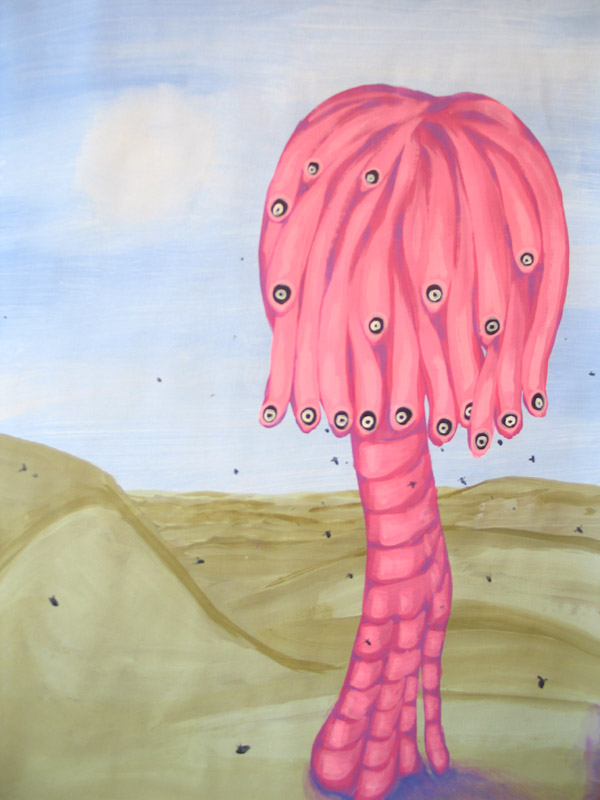
G - The Grimberry Tree


[click to enlarge]


My acquaintance Professor Amberson was traveling recently in the deep Saharan desert along with his family -- when he happened across a Grimberry Tree. This is his how he recounts the experience:

"We're traversing great rolling dunes -- swells like ocean waves in a storm, but made of blistering, dusty sand. We ran out of water a day ago. Our lips are cracked and bleeding. My tongue is a dry, alien thing in my mouth. Death cannot be far away...

But wait! Up ahead there seems to be some sort of tree, bursting from the sand. Surely this must be a mirage, I tell myself -- because the tree is flamboyantly hot pink. But so what if it is a mirage? With nothing to lose, we might as well check it out.

The sweetest smell of honey floats on the air, and the gentle hum of bees fills our ears. It's comical, it's cartoonish: this tree is straight out of a Dr. Seuss story.

And then: the 'happy little tree' lets out a ferocious roar -- like a belching lion.

A pink, slimy frond whips out fast as lightning and grabs my son by the ankle. With demon speed, the tree dashes the boy against the ground repeatedly, swinging him from the ground on the right all the way over its 'head' to the ground on the left and back again. Again and again and again!

The tree sucks Wes -- poor Wes! -- into its canopy, and chews him up with loud crunching sounds. Then: silence. My daughter Polly and I look to each other, stunned.

Just as suddenly, the tree spits out the boy's skeleton like a watermelon seed. Which lands at our feet. Thud."


The Grimberry Tree is a muscular carnivorous plant with slimy pink tentacles in place of leaves. The tree is unable to "walk" per se -- but its root-legs do enable it to stay atop shifting sands and (to an extent) to steer its course as sandstorms reconfigure the landscape around it.

The tree is not sentient -- nor does it even have a "brain," as we understand such things. However, it does have photoreceptors on the ends of many of its tentacles -- which both look and act very much like eyes. These "eyes" interact with its pseudo-nervous system in a way that enables effective attacks on large prey.

For the most part, the Grimberry tree subsists on insects, which are attracted to its distinctly honey-like scent. It also consumes birds when possible -- and as we have seen, equally enjoys human flesh. Typically animal corpses will be dropped from the tree's branches half-digested. The stink of rotting flesh helps to attract more insects. The "bait" doesn't last for long, however. Such debris is soon "washed away" and buried with the shifting sands.


[In case you're curious: Professor Amberson, Polly, and Wes all miraculously survived their encounter unharmed. I may meet up with them "on the road" in the near future. Last I heard, the family was planning an outing to Mount Etna, to take an up-close look at the ongoing volcanic eruptions.]

Sunday, October 7, 2007

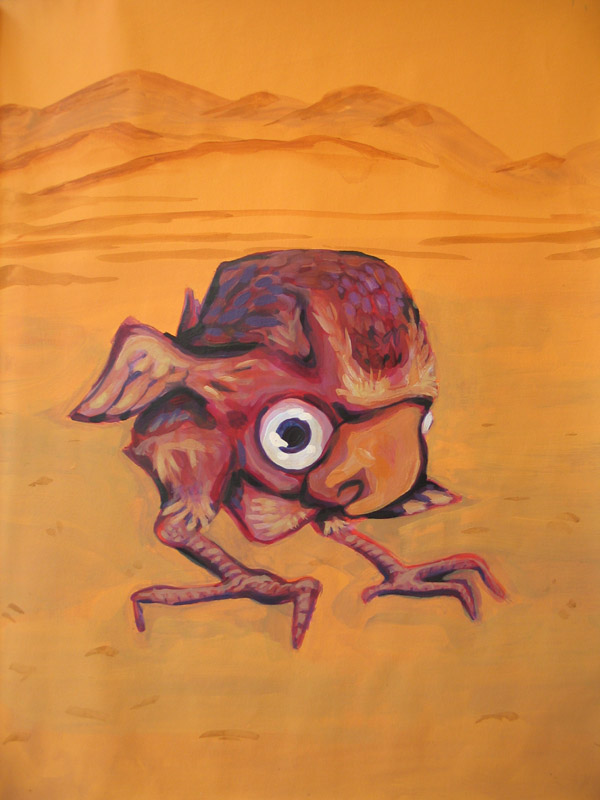
F- The Flightless Goan


[click to enlarge]


The Flightless Goan is a carnivorous, desert-dwelling bird found in the Mexican state of Coahuila. It is exceptionally fast, and has remarkably keen eyesight.

Standing at two feet tall, Goan hunt small and medium-sized game such as rabbit and coyote. Hunting is often done in groups of 2-4 animals. Their razor-sharp beaks rapidly slice prey into ribbons.

The birds have a distinctive cry -- "moh!" -- which they shriek whenever running. When they pause, the cry stops. It is a curious experience to hear the animal as it stops and starts: Moh! Stop. Moh! Stop. Moh!

Goan, it is believed, are a pygmy version of the quasi-mythical Giant Roc -- a bird allegedly capable of carrying off fully grown elephants in its claws. Recent evidence suggests that such a species genuinely did exist at one point in time, but that it went extinct long before the appearance of Homo Sapiens. The Giant Roc in European and Middle-Eastern mythology -- and the Thunder Bird in Native American folklore -- most probably emerged out of humans' attempts to explain fossil remains.

In essence, the Giant Roc seems to have been a cross between the Pterodactyl and the Archaeopteryx (the earliest known bird) -- but larger than either. It is doubtful that even the largest Giant Roc could have lifted an elephant; prey approximately the size of oxen, however, were not out of the question. Such great birds must have depended upon the existence of huge herds of prey to survive. We can guess that they were very territorial, and that due to this, successful mating was rare.

Given the immensity of their drain on the ecosystem, no one bioregion could support Giant Rocs indefinitely. As food became too sparse, mutations resulting in smaller birds were advantageous. Based on skeletal evidence, it is almost certain that today's Flightless Goan is a direct descendant of the avian megafauna. Indeed, fundamental similarities between the Goan and the Roc are so profound, some have suggested that it is only a matter of time before a random mutation in the Goan genome leads to the rebirth of Giant Rocs in the modern world.

Our collection of fossilized birds is too scanty at present to prove anything -- but perhaps over long periods of time we are seeing a cycle between the pygmy- and giant-sized version of a single bird species. If so, the phenomena would lend new credence to myths about the Phoenix that is reborn from its own ashes.

Saturday, October 6, 2007

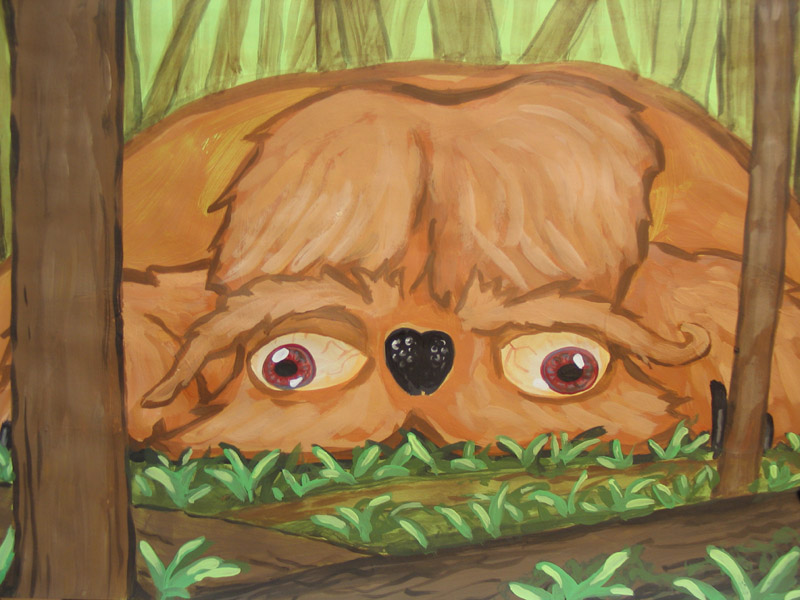
From North Korea: The Giant Mupp


[click to enlarge]


The Giant Mupp is a species of dog native to Korea. Early in its lifespan, the animal is indistinguishable from a common street mongrel. However, as it ages, a remarkable difference becomes apparent.

The Giant Mupp lacks the genetic coding that turns off physical growth. As each year passes, it simply gets bigger and bigger. Furthermore, it also lacks the related code that produces senescence -- meaning that there is no significant metabolic deterioration as it ages. Theoretically, the animal could live forever.

Only one factor limits the Mupp: gravity. When it reaches the size of an African Elephant, the sheer weight of its flesh cripples the dog's ability to walk; only by crawling on its belly is it able to move about. As the Mupp becomes even larger than this, it will ultimately become stranded in one spot.

The animal would starve to death at this point, were it not for a very unusual adaptation. The tongue begins to grow at a faster rate than the rest of the body. The Giant Mupp is able to press this organ down into the ground, and begins absorbing nutrients from the soil beneath it. Over time, the tongue actually splits and forks into many branches -- until it resembles nothing so much as a tree's root system.

But gravity always wins. As a Mupp's eyes get larger and larger, they become distorted by their own weight, flattened out. Eventually, the membranes are too weak to contain their vitreous humor, and the dog's eyeballs burst. The Mupp can live on, blinded, but other internal organs will inevitably meet the same fate. Life ends.

Stories have been told of Mupps sixty feet wide and thirty feet tall being mistaken for hills. Animals of this size, however, have not been seen for several centuries -- and likely won't be seen again. It is estimated that the largest Giant Mupps that ever existed lived to approximately 600 years. Few today, however, ever even become noticeably large.

For generations, the meat of Mupp was considered a delicacy in Korea. Due to its popularity, the native population was almost wiped out. Farmers who bred Giant Mupps in captivity harvested the animals at earlier and earlier ages, until little difference remained between the size of the Mupps being consumed and other dogs. The practice of breeding Mupps died out; the few remaining specimens have mostly been assimilated into the general street mongrel population.

Giant Mupps as distinct species lasted somewhat longer in China. During the early dynasties, Mupps were exported to China to serve as imposing imperial guardians. The "Foo Dog" has mistakenly been identified by some as a Chinese representation of the Lion. Not so! As "magic" protectors for homes of the rich, few were entrusted with the truth of the animal's origins -- but I have personally met with certain old families remaining in possession of scrolls that provide enlightenment on this matter.

It has been rumored that there are at least two Giant Mupps surviving within China's borders. It is also likely that there are still some genetically pure Mupps left in Korea, which have escaped into far-flung wooded areas.

Update: I can now confirm my suspicions. I have been to North Korea and seen for myself one living Giant Mupp in the deep woods.

Hunting the Giant Mupp


I can now reveal our current location: Seoul, South Korea.

Back in Brussels, I received word from a contact of mine in North Korea that he had a lead regarding where we might find a Giant Mupp. My contact -- a Brit expatriate -- of course had a "watcher" assigned to him by the government, making it nearly impossible to go out on an unauthorized expedition into the Demilitarized Zone...

Fortunately for us, however, the watcher was incapacitated just then -- suffering in the privacy of his home for several days with a severe case of the flu. Our window of opportunity was narrow indeed.

A North Korean farmer -- who begs anonymity, for fear of police reprisal -- is responsible for making the initial discovery. It was difficult to convince him to help us... But a year's supply of rice and two pounds of Belgian Chocolate did the trick: he agreed to guide us back to a "strange hairy hill," deep in the forest.

The Brit (as I'll refer to him) managed to procure an old American jeep for our journey -- a "junker," presumably leftover from the Korean war. Leaving the airport at Namp'o under cover of darkness, we quickly escaped civilization, winding our way through an increasingly remote network of dirt roads toward the DMZ.

***


Calamity! On the first day out, our jeep was destroyed by an exploding land mine. Miraculously, neither the Farmer, the Brit, Scarlet or myself were seriously injured.

Scarlet was thrown a good thirty feet from the vehicle as it was flipped over and torn in two. Finding my senses, I ran to her side... And she cheerfully exclaims: "This country blows my mind!"

Lord help me.

Gathering up what supplies we can salvage, our group continues on. Scarlet's barrage of "jokes" is even more unrelenting now -- but at least it seems to bolster morale for the others.

***


The Farmer holds up his end of the deal. Deep into the wet forest he leads us... And then, there it is: what appears to be a small, fur-covered hillock.

This Mupp is an old one. Forty feet across, perhaps eighteen feet tall -- and nearly 300 years old, judging by growth patterns on the claws. Unable to move, a prisoner of its own weight, the beast is now tragically rooted to that spot forever.

As we circled the thing, I made a film record of this great animal using my well-weathered Bolex camera. (I'd prefer a good new Nikon, but this is the only thing I could acquire on such short notice before leaving Brussels.)

The Farmer did something foolish then. While I was distracted, he climbed up atop the Mupp -- and shouted down to me to get a shot of him and his discovery.

I confess, I hadn't wanted to risk sharing the whole truth with our farmer friend about the nature of his "hairy hill" -- so I suppose I can't really blame him for what happened next...

Two great eyes opened. Previously camouflaged beneath matted fur and green ferns, the Farmer had not comprehended that the hill's silhouette was actually that of a gigantic, flattened dog. The Mupp emitted a deep, tired, earth-rumbling sigh -- and the Farmer panicked.

He ran off into the forest alone. We had no choice but to follow him! Without our guide, we could have been lost out in the woods for days.

Making things worse, a group of North Korean helicopters just then happened to fly overhead. Our guide, in his terror, was certain that they must be after him personally -- and so it was a long time before we managed to catch up and calm him down.

As we sat down to deliberate next actions, the desperateness of our situation began to sink in. The authorities surely had discovered our wrecked jeep. It is unlikely that they knew who they were searching for -- but a concerted manhunt was on.

***


It was only with phenomenal luck that the Brit, Scarlet, and I managed to escape the country.

Over the years, the North Korean government has drilled about a dozen tunnels beneath the Demilitarized Zone into South Korea -- preparations for a surprise attack. Four are widely known; the most famous of which is the "Third Tunnel of Aggression," discovered in October of 1978.

Our crafty farmer friend knows the location of a fifth. The South Korean government is aware of the tunnel's existence and has posted guards on their end -- but it's been kept secret from the media. (My guess is that the politicians are saving this information as a chit for later use.)

One pound of Belgian chocolate bought us five minutes in which to sneak past the North Korean guard. Three of us descended into the dark earth; the Farmer stayed behind. I estimate that we walked half a mile through utter darkness, feeling our way along the wall...

At the South entrance, the Brit was able to convince a pair of equally bored (and somewhat more drunk) guards that we were escaped political prisoners seeking asylum.

A stolen car and the rest of my pocket cash later, the three of us are sharing a small hotel room in Seoul, checked in under false names.

As for me, I call that a success.

Better yet: the Bolex is intact!

***


At this point we part ways with the Brit. I am calling in a favor with a certain oceanographer I know. He is currently doing work in Indonesia -- but has a base in southern Japan that ought to be able to send a helicopter to retrieve Scarlet and myself.

More news when it becomes available.

Friday, October 5, 2007

E - The Elysian Zorn


[click to enlarge]


A virus is unable to self-replicate except by invading the living cells of a host animal. Certain viruses are able to significantly re-write their host's genetic code. When this genetic re-coding results in "massive" transformations of the animal's outward form, the resulting creature is referred to as a "zorn." "Zorn" is not a single species, but rather a category of species: creatures whose origin is viral DNA re-scripting.

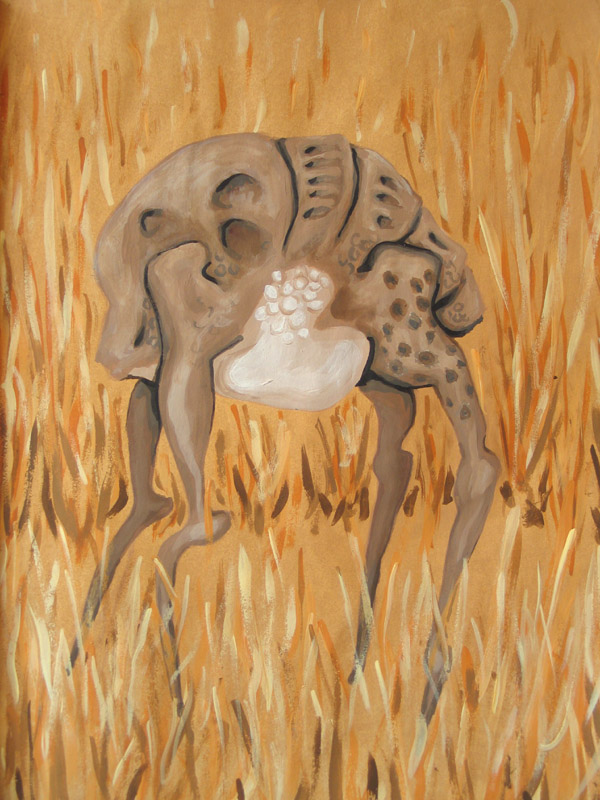
Zorns based off of giraffe, gazelle, buffalo, elephant, and baboon stock have been sighted with increasing frequency throughout central Africa for the past five decades. It is obvious from their appearance that these zorns share a common viral origin.

The animals have become headless. Their eyes and ears have been replaced with an ultrasonic echolocation system, now located in the frontal thoracic region. The truncated throat has transformed into a loosely musculatured proboscis only capable of dealing with liquified nourishment. The ribcage has reformed into a segmented shell (typically still covered by fur). The dorsal shell is perforated with orifices that excrete a weak acid solution, which the zorns use to dissolve plant materials -- which are then slurped up through the proboscis. The legs and digestive systems of the original animals remain essentially intact.

Fortunately for humankind, this particular zorn-producing virus cannot be transmitted by casual contact. It must be injected directly into a host animal's bloodstream. However, once the animal has become a zorn, the condition is inheritable. All subsequent offspring share the parent's new form... Zorn herds are increasing.

What is the original vector of this viral strain?

With great difficulty, I have tracked the virus back to its source: Martian insect megafauna. These are colossal flea-like creatures, the height of a two-story house. They are omnivores that occasionally enjoy meat -- and they are extremely effective hunters. After capturing their prey, they trap it in a cocooning blanket of slime, and then inject it with digestive juices that slowly liquify their intended meal from the inside out. On very rare occasion, some of the prey have managed to escape. These "lucky" ones became the first zorn of their kind.

It is my belief that there are only two or three of the giant insects on Earth at present. I believe that they were brought to our planet entirely unintentionally, during the course of black market trading between Earth and Mars. Certain foreign correspondents of mine have linked this particular insect species specifically to Elysium -- a large volcanic region of Mars, stretching roughly between 15º-45º latitude and 130º-160º longitude.

Knowing this, the zorn that we are currently seeing in Africa should properly be identified as Elysian Zorn. (Zorn are typically named after the location where their viral mutagen first emerged.)

Because the Elysian Zorn virus is only transmissible via direct injection into the bloodstream -- and because we know the original vector of transmission -- we have an excellent chance of being able to contain this outbreak before it spreads farther... If authorities are willing take action.

However, proliferation of the Elysian Zorn is indicative of a even larger, more insidious problem. Given that the first record of an Elysian Zorn in Africa dates back to 1863, we can reasonably extrapolate that illegal trafficking between Earth and Mars has been going on for at least 150 years.

Contact between the two planets is hopefully still a rare occurrence -- but every instance is a new opportunity for disease and invasive species to spread into environments where they do not belong. Elsewhere I have written about illegal importation of the "Opium Gore Golem" by certain drug cartels... What other dangerous species are already here among us?

Thursday, October 4, 2007

An Open Letter to "Monster Month South"

A new addition to our cause of Cryptid Awareness!


From Monster Month South:

"Throughout October, my cousin Raymond Jefferson Legrasse, a fisherman on the bayou, will be sharing sketches of some of the...wildlife...in his neck of the woods, which has gotten a bit strange since the storm. I'm compiling the illustrations into a bestiary and posting them, along with some of his colorful descriptions [...] A new creature will be posted every day of the month, and he tells me that there may even be a photograph or two, if he can wrangle something up."


Dear Mr. Jeffrey C. Roche,

Having just perused your "Monster Month South" web log -- forwarded to me by my associate Mr. Bonnichsen -- I must say that I am quite impressed. In the current climate of skepticism toward any claiming to have seen unusual animals, it is an act of intellectual bravery in the extreme to give your support to Mr. Raymond J. Lagrasse's claims.

Beyond merely lending a credible ear, you have amplified his voice. I thank you! So often my most remarkable discoveries have been due to information gleaned from sources just such as this -- sources deemed "unlearned" or "rustic" by the narrow-minded men controlling American academia.

With your permission, may I laud you publicly and lend what little standing I have to your noble cause?


Sincerely yours,
Professor Ichbonnsen

D - The Dark Strider


[click to enlarge]


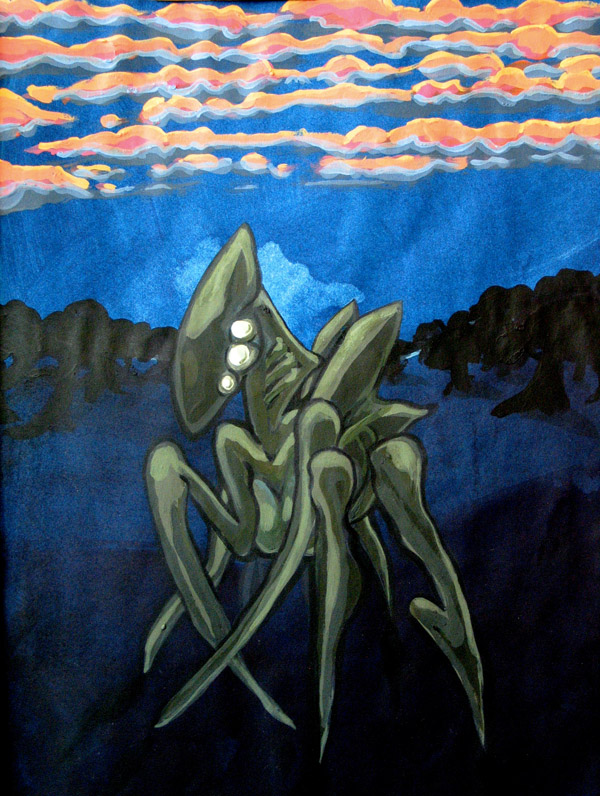
The Dark Strider is clearly insectoid in origin, having six legs and vestigial wings. However, in many respects its form and temperament are strikingly equine in nature. Indeed, seen at a distance and in dim light, the animal is easily mistaken for a wild horse. It stands approximately eight feet tall (6 ft at the shoulder) -- and when it runs, its gait is best described as a gallop.

The front two legs are sharp spears, much like those of a Praying Mantis. Contrary to appearances, however, the Dark Strider is vegetarian. These frightful weapons are used purely for self-defense and grooming purposes.

Most Dark Striders seem to suffer from parasites -- in particular, a translucent, apple-sized grub known as the "Noub." Noubs attach themselves to the Dark Strider's back, typically behind the vestigial wings, where it is difficult for the skewering front legs to reach.

Noubs are a constant source of irritation, as they emit a high-pitched chirruping whine for hours at a time during the night. This noise poses a serious threat to the Dark Strider: predators are often attracted to the sound. Yet, a strong fight-or-flight response makes the animal difficult prey to fell.

The Dark Strider is native to Romania, but is far-ranging in its travels. Following our successful efforts to tag a Dark Strider with a radio transmitter, my colleagues the Quay Sisters have reported back that the animal seems to have a particular affinity for Czechoslovakia. Perhaps this is an ancestral home, where the species returns to breed -- just as salmon instinctively return to their place of birth.

The Dark Strider is a purely nocturnal creature, only venturing out from its murky forest shelters as twilight ebbs into night. It is extremely solitary for most of the year; however, on occasion, a small group will inexplicably gather together in a moonlit glade. During this meeting -- a "forum" as it has been picturesquely termed -- the animals seem to communicate with each other. The purpose of these gatherings remains a mystery.

Wednesday, October 3, 2007

C - The Cradle Robber


[click to enlarge]


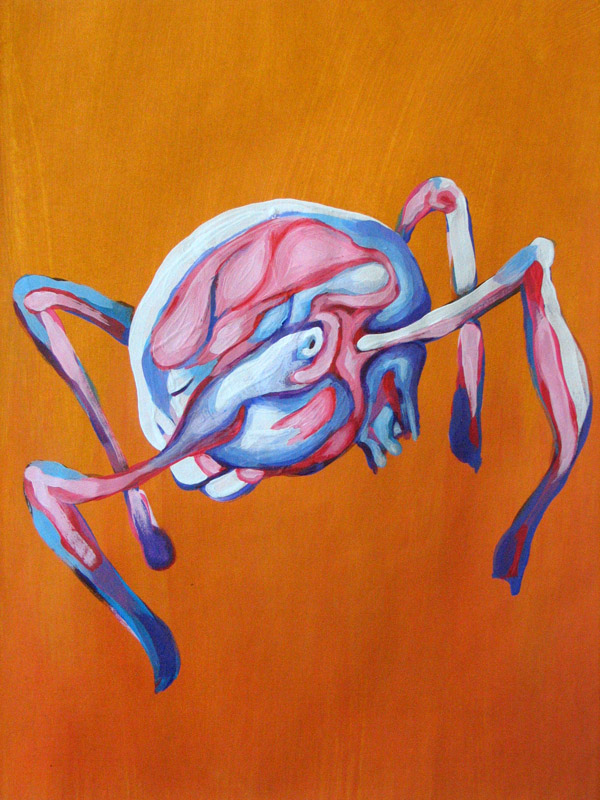
The Cradle Robber is a pale blue, four-legged, spider-like creature.

What is most remarkable, however, is that the animal's carapace is almost exactly the same shape and size as a human infant's severed head. This gruesome camouflage has been to put to good effect by the hunter in its preferred environment: mass graves.

The creature's body is covered by a bone exoskeleton, with exposed muscle groups and vein systems on the sides. Its slimy red eyes and prehensile mouth-fingers are located where the neck of the "baby head" seems to dangle. Indentations on the back of the carapace simulate the baby's mouth, nose, and closed eyes.

Cradle robber populations flourish during times of war or plague. The animals crawl into pits of dead bodies being readied for burial, and then wait patiently for their prey. Bereaved parents searching for lost children inevitably find their way to the graves... And then as the mothers and fathers kneel over piles of corpses, weeping and looking for their offspring, the predators strike.

When plagues are at their height, the animals have sometimes been emboldened to venture into the heart of human communities. Terrible tales have been told of the Cradle Robber that sneaks into a nursery, kills and consumes a child sleeping in the crib, and then waits for the parents to return -- sitting motionless there upon the bloody pillow, as if it were a wet nest.

During periods of peace and human health, the Cradle Robber population shrinks and retreats into dry underground tunnel systems. Clutches of eggs have been found secreted inside both French and Czech ossuaries.

There are large periods of history where the animal seems to be entirely absent from written record. It is possible that the Cradle Robber population collectively goes into a period of hibernation when the environmental factors that support its survival are no longer right.

If so, then we must ask: how does the species wake up again? At this point in time, the leading theory is that the Cradle Robber has a symbiotic relationship with rats -- which also prosper during times of human suffering. It is suspected that there are certain chemical markers in the urine of rats eating human flesh that serve as the wake up signal -- much like the ammonia component of smelling salts.

Evidence of Cradle Robber populations has been found throughout Europe and also the western reaches of the former Soviet Union, reaching back to Roman times. In recent years, rumors have circulated about a subspecies of black-shelled cradle robbers being sighted much farther south, in Rwanda and Darfur. Further investigation is required.

Tuesday, October 2, 2007

Leaving Brussels


After two weeks of lobbying the European Commission (the EU's executive branch), I am departing Belgium in disgust. While a few members of the cabinet have quietly expressed interest in my findings about the proliferation of Elysian Zorns, officially I have been branded as a persona non grata -- barred from entering the Berlaymont building.

My intern Scarlet and I will leave forthwith. Tomorrow morning, hours before daybreak, we will stow ourselves in the hold of a cargo plane owned by a certain Algerian pilot sympathetic to our cause. A man who -- I might add -- despite having only one eye, has more vision than all the politicians of the Continent combined.

Scarlet, as always, seems to enjoy the skulduggery of all this. Her joking is relentless. (I can see why EarthWatch wanted to be rid of her.)

Myself, I am humiliated to have to descend to this mode of travel... But it is a necessity. An opportunity has arisen in the Far East -- and nothing will stand in the way of my seizing this moment.

For reasons of safety, I'll withhold saying more about where we're headed until we've arrived.

B - The Badogedown


[click to enlarge]


Nearing the end of 2007, the world population of badogedowns stands at approximately 30 animals. The species was believed to have gone extinct in 2005. However, under condition of anonymity, it has been revealed to me that two private collectors have managed to preserve several animals, and are quietly pursuing a breeding program.

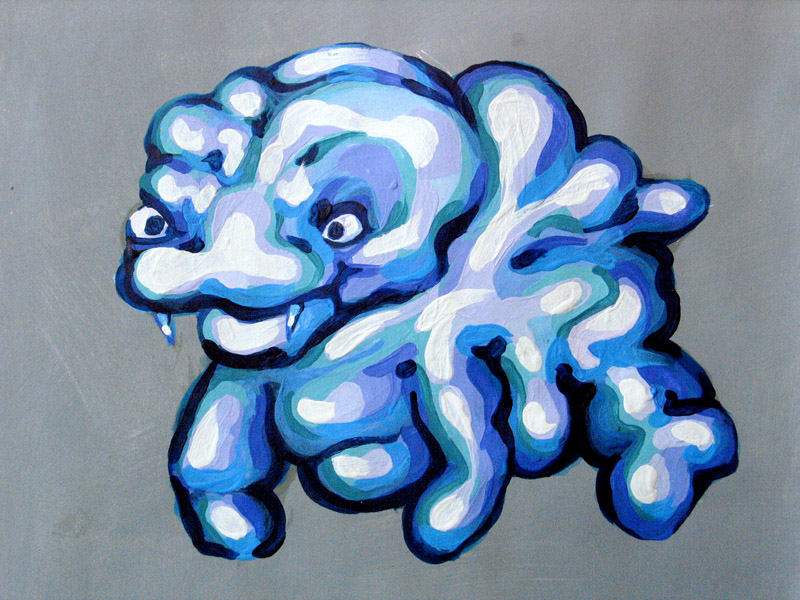
The Badogedown is a rubbery, blubbery, gelatinous sort of puppy dog. It is not the result of natural selection, but rather a failed attempt at genetic engineering undertaken during the early 2000s by corporate interests.

Two companies, one in Japan and one in the USA, are responsible for producing the new species. Their intent, it seems, was to capitalize upon the designer toys/urban vinyl movement by producing a living pet whose flesh emulates the texture of shiny rubber toys. They hoped to appeal to the aesthetics of parents who grew up in the 1970s, who would then purchase the pups for their target market: young girls, ages 10-12.

In most respects, the companies' scientists were eminently successful. The Pekinese-sized pooch both looks and feels like a living toy. Furthermore, the Badogedown's character is ideally suited for family environments: its enthusiastic affection and loyalty toward children is truly unparalleled. When the dog is brought home, it bonds to its young new owner almost instantaneously, and the two become immediately inseparable. It follows the child around wherever they go, relentlessly leaping up and happily licking the youngster's face.

Unfortunately, there are two tragic flaws in the animal's make up, which genetic engineers were never fully able to eliminate...

The dog has no ears. As it affectionately assaults its human master, there is simply no way to call it off.

Worse yet, the Badogedown possesses two very sharp fangs. Consequently, in the several test groups of young girls that it was exposed to, the animal's paroxysms of love invariably resulted in serious injury. (Quite unintentionally, on the part of the dog.)

Even after these tragic incidents, it was several years more before the "vinyl love dog" project was finally brought to a halt and the animal population destroyed. It seems that this delay resulted from a peculiar communications breakdown during the international collaboration.

Product testing for the pups was done in the USA; the Japanese project leaders were only able to listen in via teleconferencing. The young girls' screams of terror were misinterpreted as shrieks of pleasure. In Japan, "bad dog, get down!" was believed to be an unknown English colloquialism of affection... Which resulted in the Badogedown's name: a Japanese transliteration of the exclamation that that each and every test subject was heard shouting.

Attempts to file down or mechanically remove the teeth have all been unsuccessful. Likely due to the addition of rodent DNA, the teeth regenerate and continue to grow quickly during the animal's entire life-span. Corporate interests finally were forced to admit failure.

However, ego and soft-heartedness are stubborn traits. There is reason to suspect that the two individuals who have preserved the Badogedown species were in fact scientists who worked on the original "vinyl love dog" project. Facing the prospect of their creations being exterminated and all records erased, I believe that they smuggled out a handful of pups -- and have since continued on with their "labor of love."

My contacts have not been forthcoming with details about where the dogs are currently being kept -- but they assure me that all necessary precautions have been taken to keep the animals safely contained in captivity.

Monday, October 1, 2007

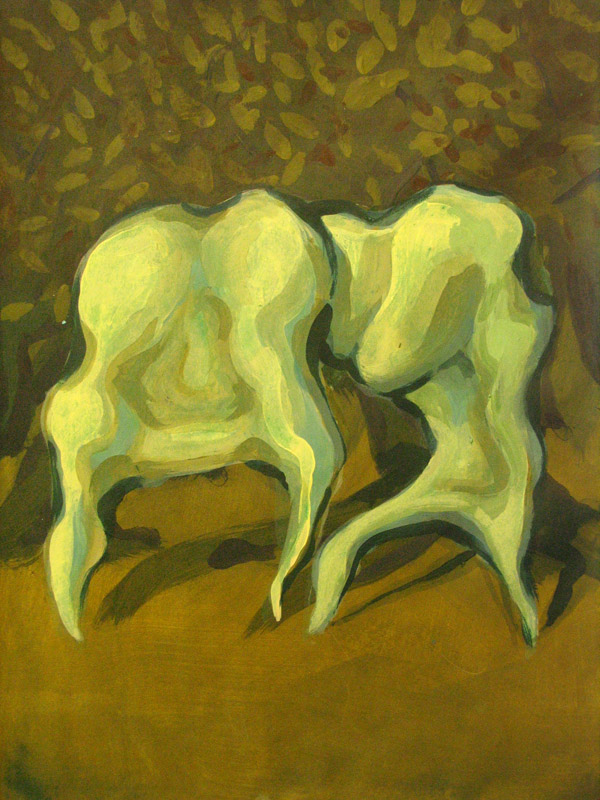
A - The Adameve


[click to enlarge]


The Adameve is a large, glistening white, maggot-like beast. It has a grossly oversized, eyeless head, and two long facial feelers that are nearly identical in shape and size to the legs.

The creature is bipedal -- yet often gives the appearance of moving on four legs. Being completely blind, it uses the facial feelers to help find its way along the ground, moving them in a sort of "walking" motion.

At maturity the Adameve can stand as much as twelve feet tall. Folded in half as it travels, the dorsal crest will measure approximately six feet up from the ground.

The species is known to haunt certain old, blasphemous orchards in England and western Europe. Primarily nocturnal, for centuries its rambling gait has caused witnesses to mistake this monster for a ghostly couple: a naked man and woman silently dancing together beneath moonlit trees.

This impression, combined with the association with apples, likely explains its name: a conjunction of "Adam and Eve."

To reproduce, the hermaphroditic Adameve injects its eggs into apples growing on the trees -- thus supplying the young with a ready-made supply of food when they hatch. In their early stages, the larva are easily mistaken for maggots writhing in and out of rotting, fallen fruit.

Adameves are extremely territorial. The young (initially numbering in the hundreds) will quickly tear each other apart, competing for dominance. Near the end of the frenzy, the most aggressive children will gang up to kill and eat their own parent. Ultimately, only one animal survives in the orchard.

Based on historical records, it is believed that the species spawns approximately once every hundred years.