Monday, October 22, 2007

S - The Slivener


[click to enlarge]


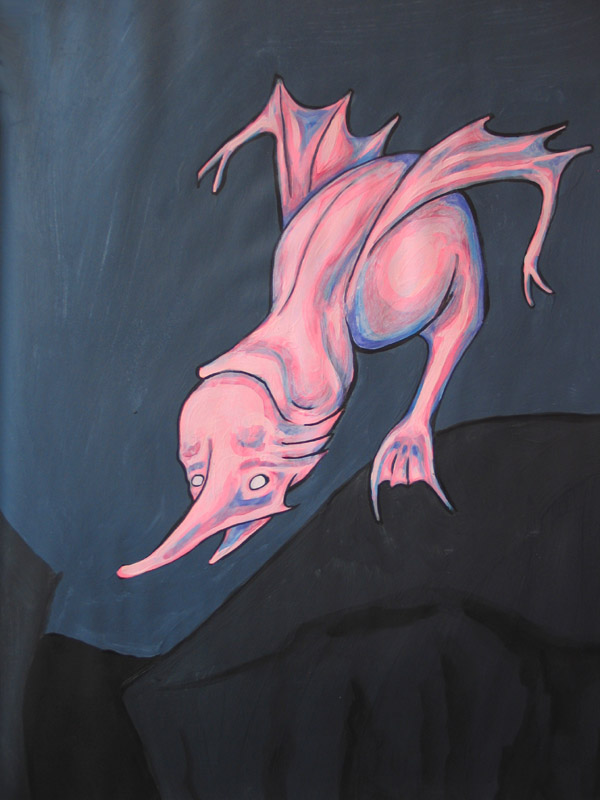
The Slivener is a twelve-foot-tall giant living deep in the forests of Kazakhstan. It is humanoid, has paper-white human-like skin, and seems to be nocturnal.

Not enough is currently known about the animal's biology to properly classify it. In some respects it is like a great ape, but in others it is more like a frog or the common housefly.

The most remarkable thing about the Slivener is its tongue. At first glance, it seems that the creature has pink, writhing tusks. However, it turns out that this is actually a single organ that protrudes from two facial orifices.

Bafflingly, the enormous snake-like tongue is unattached to the rest of the organism. It is able to slide back and forth between sides of the creature's face, always becoming longer on one side and shorter on the other.

The leading explanation for this is that the tongue is actually a separate, symbiotic animal. If so, we are looking at a truly unique evolutionary partnership.

One must ask: Can the tongue survive independently if removed from the Slivener? And if so, for how long?

Initial experiments aimed at answering these questions have proven... ill-advised. Further research -- and further researchers -- will be required.

Sunday, October 21, 2007

R - The Rasch


[click to enlarge]


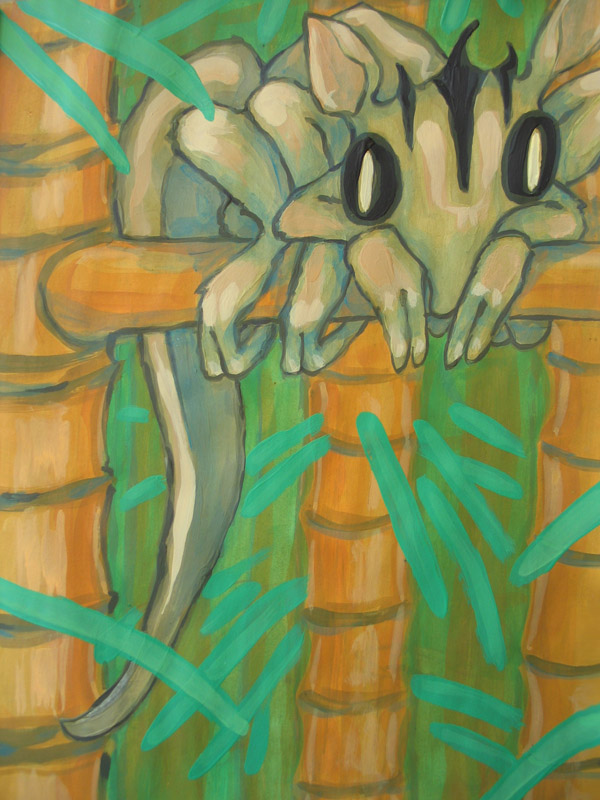
The Rasch is a six-legged marsupial that lives deep in the bamboo jungles of China. It is named after the German explorer who first brought news of it to the Western world in 2006. Strangely, Chinese cryptozoologists don't seem to have been aware of its existence before then.

The animal is primarily arboreal, and has a long tail that helps it keep balance as it leaps from tree to tree. The fur is predominantly light gray, with three distinctive black stripes on the head. Its eyes are often said to be "flashing"; they are usually so dilated that they appear entirely black -- except for when light reflects off the retinas and they seem to glow (much like a cat's eyes at night).

The Rasch is highly animated. It has a metabolism that is in over-drive. During the course of a 24-hour period it never sleeps. It is in constant motion seeking out flying insects, which are its food. Every action is fast, alert, and precise.

The price for life on fast-forward is an early grave. The Rasch is only conscious for three weeks. At the end of this period, it buries itself deep in a burrow and goes into a comatose state -- which it will remain in for the rest of its life, approximately 15 years more.

When the Rasch goes dormant, it takes its offspring with it to this "grave". The several young it has in its pouch will spend the next decade slowly developing -- before bursting to life for their own brief period of consciousness.

One must wonder: Sleeping for almost 25 years of its existence, what does a Rasch dream about?

Saturday, October 20, 2007

Q - The Quillaupus


[click to enlarge]


The Quillaupus is native to New England, where it is usually found amongst woods of birch trees. It is furry, with blue and purple stripes. This makes for terrible camouflage -- which is presumably why it evolved to arboreal existence.

The animal has many sharp quills -- and many sharp eyes for sighting its prey. Its method of attack: the prehensile tail loosens its grip on the tree branch where the creature hangs, and the Quillaupus simply drops down upon its victim from above.

The typical Quillaupus is approximately the size of a raccoon; it preys primarily upon squirrels and birds. However, there is record of one Quillaupus that grew large enough to swallow a grown man in one fell swoop. Luckily for this man, the beast's teeth became lodged in the soil, and he was able to dig his way out to safety.

Friday, October 19, 2007

P - The Pak Mozg


[click to enlarge]


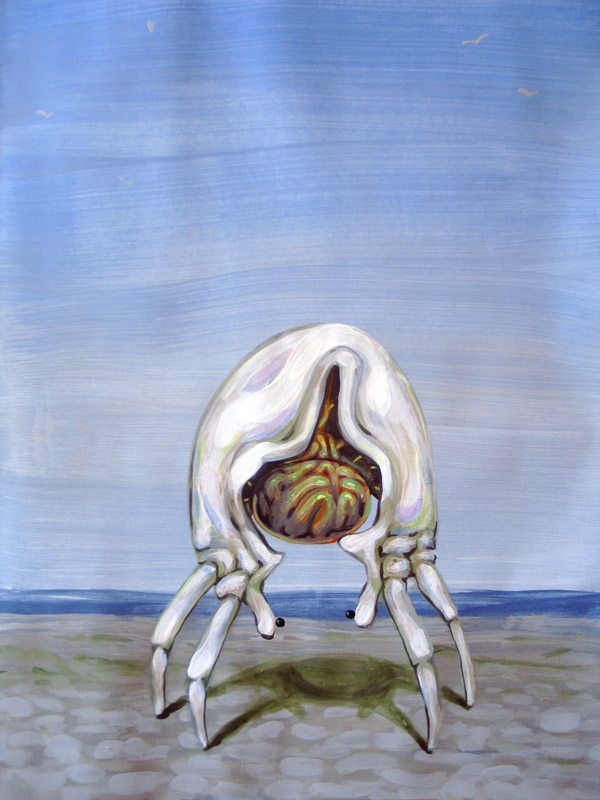
"Pak Mozg" roughly translates from Russian to English as "brain crab." It is a species that has recently been found on the southwestern coast of Novaya Zemlya -- an archipelago to the north of Russia, relatively close to Scandinavia.

What makes this crab interesting is that it has an exceptionally large brain, which dangles exposed beneath its dorsal shell. The ventral shell is entirely missing. This makes the crab quite vulnerable to attacks from seagulls -- but it is also, presumably, what makes the prodigious brain development physically possible.

The typical adult Pak Mozg is approximately 10" wide and 14" tall. Its dorsal shell is high and crested, which makes it look somewhat like a helmet. To an extent, this unusual shape helps deflect gulls' attacks.

If the crab is turned over, you can see the web of its nervous system adhered to the shell -- as well as a vestigial stomach lining. The creature seems to subsist solely upon zooplankton, which are captured by a swath of microscopic flagella. Two beady black eyes dangle from protuberances at the front of the shell. The only significant musculature occurs within the creature's four legs.

From 1954 to 1990, Novaya Zemlya was used as a nuclear test site; in the end, it hosted a grand total of 224 detonations. While there is no definite link between the tests and the appearance of the Pak Mozg, the concurrence of these events merits further investigation.

At this point in time, it seems that only a handful of fishermen have taken note of the new species. The ones I've spoken to jokingly refer to it as "the intellectual." When they see gulls flip the crabs over and peck out the brains inside, wry comments are made about the appetites of these "government agents."

Whether or not Pak Mosgs survive into the future is uncertain. On the one hand, they are astonishingly vulnerable to predators -- which seem to enjoy the crabs as a sort of delicacy. On the other hand, the animal displays a high degree of intelligence and adaptability.

It is known, for instance, that the first recorded generation of crabs attempted to lay its eggs on land in the daytime -- and was consequently slaughtered en masse by hungry birds. In the following generation -- several years later -- the crabs appear to have avoided the threat by laying their eggs at night. The most recent generation is reported to have stolen nets from nearby fishing boats -- and actually laid rudimentary traps for the predators.

It will be very interesting indeed to see how this trend develops over time.

Thursday, October 18, 2007

O - The Opium Gore Golem


[click to enlarge]


The story as it's told is this: The most powerful and vicious drug lord in Afghanistan captured and enslaved a wizard. After suffering hideous torture, his body and will broken, the wizard finally consented to do his captor's bidding -- to summon up a commando of demon soldiers. The Gore Golems' bodies were constructed from the entrails of a hundred slaughtered enemies, and then animated by each being fed a portion of the wizard's own soul. The grizzly monsters now serve as the drug lord's personal body guard. They are unstoppable in battle; even the bravest man is paralyzed with fear when confronted by their demonic visage.

The truth of the matter is more mundane -- yet no less strange.

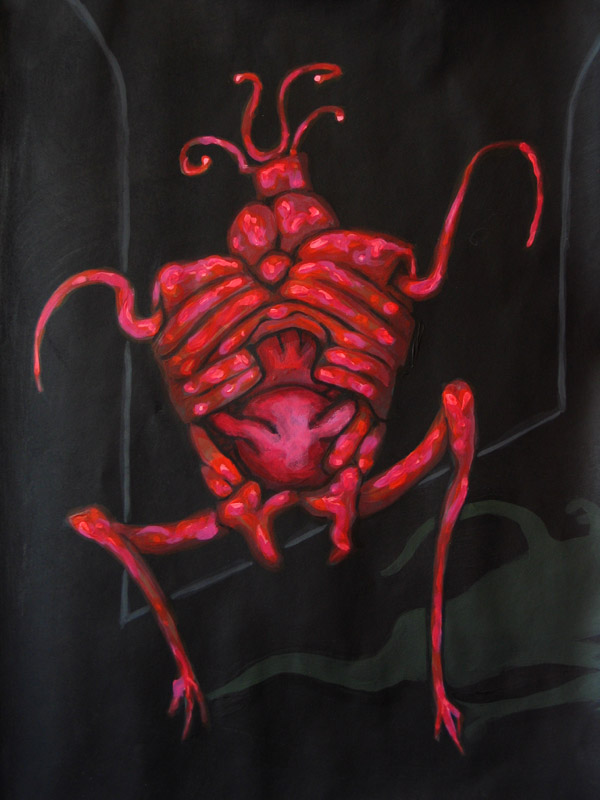
The "Gore Golem" is a semi-intelligent, quasi-insect species imported from the deep caverns of Mars. It is believed that six are currently on Earth, and it is true that they are in the possession of an Afghan Opium cartel.

The creature -- whose proper name is unknown -- is a horrid sight to behold. It stands between eight and nine feet tall. The barrel chest has two overlapping ribcages, and an exposed double-stomach digestive system. The thing is covered in grizzly, glistening shell armor -- which sweats blood, so that it's constantly coated with a wet red sheen. It is bipedal, walking on skeletal legs that somewhat resemble those of a grasshopper. The arms are dangerous whipping tentacles. The mouth is concealed in a thick, stump-like neck -- which is guarded by four miniscule eyes at the ends of long, prehensile stalks, that look quite like writhing worms.

"Gore Golems" are not intelligent enough to act as independent mercenaries; their mental capacity is similar to that of a trained horse. However, the animals are deeply susceptible to hypnotic suggestion. By entering a drug-enhanced meditational state, human handlers are able to command the "Golems" almost as if they were extensions of their own mind.

Indeed, over time as the telepathic bond between handler and animals increases, the human becomes able to control them from great distances -- even when they are miles away and out of sight. Given the tactical advantages this presents, drug lords are prone to choose their best and brightest soldiers to manage the Martian beasts. But, the power that the "Golems" grant is not without a price. Human beings who attempt to control these terrifying instruments of death are quickly drained of their mental and physical strength; no master has ever lasted more than six months.

When the handler dies -- eyes wide open, mad and staring -- the "Golems" go into a wild frenzy, killing and destroying everything in their path. Recapturing them and putting them under human control again is a difficult feat, always accompanied by loss of life.

Among certain opium-trafficking drug lords, possession of the "Golems" has become something of a status symbol. More than once, one of these men has ruthlessly executed a rival and tried to steal the beasts for himself. It is rumored that during a botched attempt at theft, one of the six animals escaped, and has since been running amok somewhere in the Hindu Kush mountains.

Cartel use of these creatures violates both international and interplanetary law (United Nations special code). My "foreign contact" has hinted that a mission may be afoot on his end of things to deal with the problem -- but details beyond this are not forthcoming.

A last detail, which I am reluctant to mention. Beyond the sheer physical power of the "Opium Gore Golems", and the undeniable psychological impact that they have on their foes, the creatures are also valued for their detachable shadows. When commanded to, the animal goes into an inscrutable dormant state, and its shadow rushes off from battle to report to its human master. I have witnessed this with my own eyes... And while I have no explanation as yet for how such a thing is possible, I continue to insist that it cannot be "magic."

Wednesday, October 17, 2007

From India: The Grrrheart


[click to enlarge]


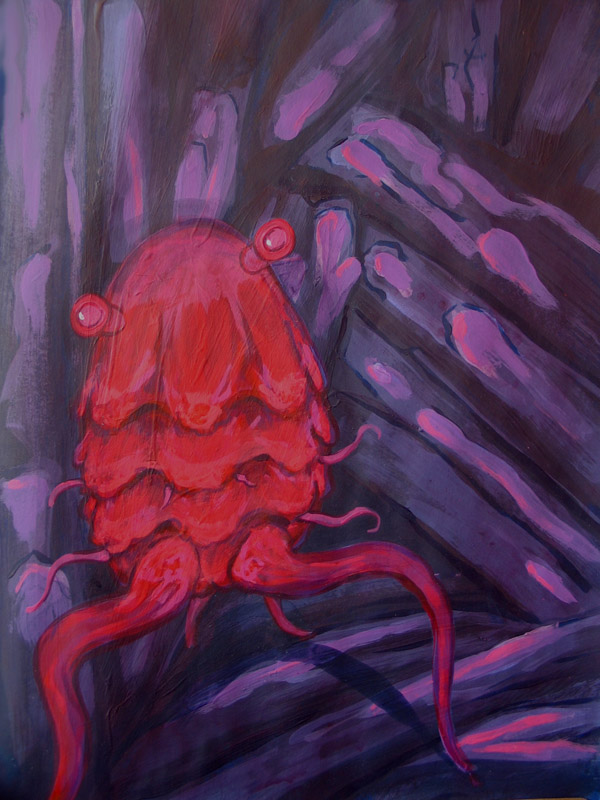
The Grrrheart looks like a red jellyfish with four strong tentacle legs. The average specimen is approximately 2 feet tall, and has two eyes on stalks at the top of its body. The body appears to be composed of three overlapping "caps," from which lesser tentacles protrude. The entire animal is somewhat translucent.

The only known examples of this species were discovered in 2007 in a deep cavern in the Indian state of Meghalaya. They are apparently amphibious, being equally at home on land and in the water. It is hypothesized that they subsist on cave crickets and fish -- although evidence to support this idea has yet to be gathered.

Grrrhearts are profoundly malleable. They are able to travel quickly through cracks in the stone that are no more than an inch in width. It is unknown whether this is a prehistoric species that became trapped underground far in the past, or if it is more closely related to modern day jellyfish -- possibly even going back and forth between the caves and outside bodies of water. The fact that the animal is not blind lends some support to this second possibility.

The Grrrheart lives in large communities. When one animal is threatened, it lets out a warning cry -- which sounds much like the furious growling of a small dog. Dozens of Grrrhearts will rush to its aid.

Despite this fearsome first impression, however, the Grrrheart seems to have a generally non-aggressive, even playful nature. When gathered all together, great numbers of Grrrheart have been observed apparently "dancing" with each other, simply for the pleasure of it.

Scarlet Saves The Day


After my adventure with the Porpische, Scarlet and I spent several days enjoying the hospitality aboard The Oceanographer's science yacht. Such meals! Would that I could afford a world-class chef to accompany me on my journeys...

But duty calls. Three days ago we received word from a contact in India that something peculiar had been sighted in a newly discovered deep cave system. What a stroke of luck then that one of The Oceanographer's Indian interns was just about to return home! We said our goodbyes, boarded another helicopter, and a few hours later found ourselves on the tarmac in Calcutta.

My friend Himmat is an environmental activist. Contrary to what readers in the USA may be thinking, this has actually made him quite a popular man. He has spent the past 30 years going to mining communities -- often operated by foreign interests -- documenting the harm that has been done to the land and human health, organizing the workers to improve conditions. One of the miners he worked with ten years ago gave him the tip that set our adventure in motion.

***


The Miner is a foreman at the coal mine where he works, so he had no trouble smuggling us into the operation after-hours the next night. With Himmat, Scarlet, and myself close behind, he led us down through low black corridors, deep into the earth.

The Indian state of Meghalaya is famous for having a huge number of caves -- few of which have been adequately explored yet. A new side passage toward the bottom of the mine had accidentally broken into one of these caverns. Where (or even if) it opens up on the surface is as yet unknown.

Only The Miner had gone through to the other side, so far. What he'd seen there -- something fast and shiny -- had disappeared too quickly for him to get a good look. Whatever it was, though, it was unlike anything he'd ever seen before. He seemed tense, concerned about what threat an unknown animal down there might pose to his men.

Scarlet, on the other hand, seemed completely at ease. As ever, her jokes were relentless... Jokes about Santa Claus gathering coal for stockings. Jokes about canaries in coal mines. Singing: "girlfriend in a coal mine, I know, I know, it's seeeerious..." I was just about at wit's end.

Himmat gave up trying to translate her before we'd gotten even three levels down.

***


One-by-one we crawled through a small hole in the wall. Ten feet crawling on our bellies -- and then it opened into large, wet room the size of an opera house.

Despite having brought some powerful lamps with us, it was difficult to see how far the cave extended. We decided to forge onward and get a sense of the place.

Caves are not like human-made tunnels. There are massive stone hills to go over or around; there are chasms hundreds of feet deep to avoid; progress is slow and dangerous. Thus, we all felt a great deal of relief when, after perhaps two hours, we finally came to a smooth patch.

It was almost like a subterranean street. From what we could tell, we were walking a path carved out by a river thousands of years ago. Clearly it had been wide and powerful in the past -- but now, only a small stream remained. Spirits renewed, we quickened our pace.

Leaving the "opera house," we traveled through perhaps a mile of smooth, curving passages. Sometimes we had to duck down, when the ceiling was a mere four feet high -- at other times, we walked comfortably upright, the ceiling 20 feet above.

Then we reached the end of the line: a sheer cliff, dropping fifty feet down into a great underground lake. Our companion, the small stream, leapt from the ledge, and we could hear the distant impact of it joining the water below.

The lake room swallowed our light. There was no way to gauge how far back it went. So, with nothing else to do, we turned around and started back toward the entrance.

***


Scarlet was the first to sight the creature. She stopped and pointed to a shadow moving up ahead. We shined our lights on it...

Two feet tall, it looked like a sort of red jellyfish, standing upright on four tentacle legs. It had two small eyes on stalks -- which twitched from side to side, apparently irritated by the light. It stayed its ground -- and began growling furiously at us.

"It's so cute!" Scarlet exclaimed.

Then, a squirting sound. Dozens of these creatures are popping out of narrow cracks in the walls, heeding the warning cry of the one we've startled. Almost immediately we're surrounded.

Sixty-odd jellys are in the corridor encircling us. Every one of them growling. I'm thinking about what I know of poison jellyfish stings, and how many miles it must be to the closest hospital -- after getting past the boulders and chasms back in the "opera house."

Scarlet, on the other hand, is laughing her head off.

***


"Well arnchoo just the most vicious little squidlets?"

"Arnchoo! Arnchoo!"

The creatures go deathly quiet. They look just about ready to pounce...

And then Scarlet starts singing:

"You better run, you better hide
We gotta keep you out of sight
Be careful Sigmund.

The other monsters put you down
cause you're not mean
And now we've found
A friend in Sigmund.

Who ever heard of a friendly sea monster
Lovin' and laughin' his life away?"


It's unbelievable... But the beasts seem to like it! The first one that spotted us -- it's tapping its foot against the floor. And then the whole lot of them, they're -- there's no other word for it -- dancing!

The whole room full of "vicious squidlets" is dancing, spiraling around each other rhythmically. In fact, there's one pattern of moves I'd swear is the "Do-Si-Do"...

***


I point back down the tunnel, and Scarlet gets my drift. She continues singing the theme song from "Sigmund and the Sea Monsters" over and over again -- and begins edging toward the underground lake.

The creatures follow!

Just like the Pied Piper of Hamelin, she leads the whole crowd of creatures back to the lake -- even more of them joining us along the way. And then she just stands at the edge of the precipice, singing her lungs out... And the beasts happily throw themselves over the side, down into the water.

Keeping my wits about me, I captured the entire spectacle at the lake on film. The last of them goes in -- and with great relief, we head back for the entrance.

***


Himmat, Scarlet and I part ways with The Miner at the facility's gates.

Himmat drives us back to his house, two towns over, where we can discuss next actions and catch some much needed shut-eye... Although, we were all so excited from the night's events, it was several hours before any of us could let go of the conversation. A new species! Other scientists must be brought in!

Given her role in this matter, I think it's only fair that Scarlet gets to name the creatures. And I will stand by that decision... Even though I do wish that she could have chosen a more dignified, scientific-sounding name. "Grrrhearts?"

"Because they're all... GRRRRR!! But then you realize that they're just a bunch of sweethearts!"

This is her explanation.

Well, she and I are clearly not cut from the same cloth -- but all the same, I'm beginning to think she has it in her to become a fine Monster Hunter after all.

***


Meanwhile, unbeknownst to the three of us, The Miner had other plans. It seems he was much more shook up by the experience than we'd realized. His only concern had ever been for protecting his men... Even if the creatures could be successfully pacified, he figured, their existence must surely lead to the mine being shut down and jobs lost.

After we left, he went back down to the cavern entrance with explosives and collapsed the whole area.

It's likely that the Grrrhearts, which lived much farther down the passage, are unharmed... But it looks like we won't be able to get back to them any time soon.
Tuesday, October 16, 2007

N - The Noble Shelkay


[click to enlarge]


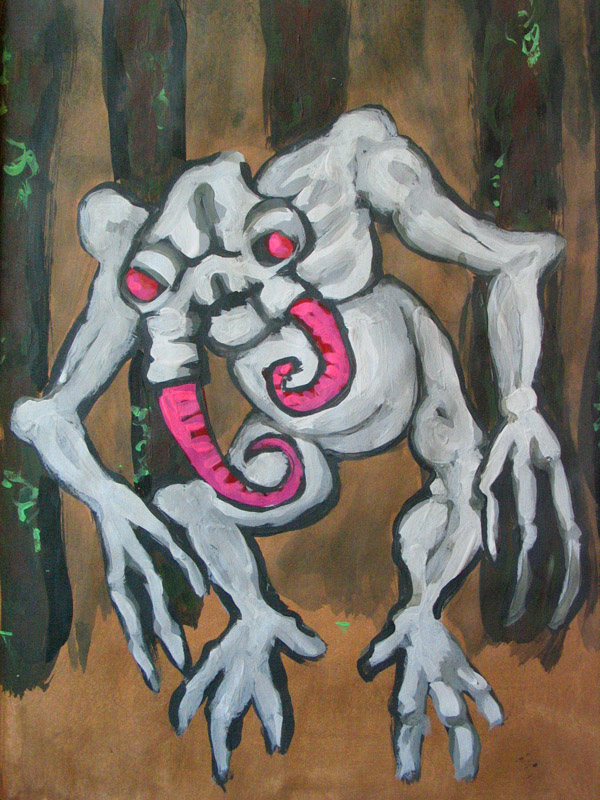
The Noble Shelkay is sort of a half-onion, half-periwinkle, half-rose creature. It lives in the most ancient of forests, building nests inside of enormous, mossy old trees.

Noble Shelkays live in small colonies with their own kind, eating flowers. They appear to co-exist quite harmoniously with the birds, mice, and moths that also share their tree-homes. The creatures seem utterly content; only on the rarest of occasions will Shelkays venture away from the nest.

The Noble Shelkay has a pretty chirping voice. The sing-song sounds it makes may in fact be a language -- but as of yet it has proven incomprehensible.

Monday, October 15, 2007

M - The Mountain Howler


[click to enlarge]


The Mountain Howler is native to Canada's Yukon Territory. It looks rather like an enormous yellow slug with two legs and a cavernous mouth.

The Mountain Howler is typically 2-3 feet in length. It consumes moss and lichen as it climbs sheer mountain cliffs. The Howler is distantly related to gastropods; however, unlike snails, its segmented shell grows internally -- providing it with a pseudo-skeleton. The rigid "legs" act much like pitons, assisting the animal during its climb.

The creature has no eyes to see with. However, it does have an excellent sense of hearing. When it comes time to mate, Howlers announce their presence to one another with an echoing breathy call, which sounds quite similar to a howling wind.

Like slugs, Mountain Howlers are hermaphroditic but need to come in contact with another of their species to accomplish fertilization. Also similar to slugs, concluding mating often requires apophallation.

Sunday, October 14, 2007

L - The Littlefoot


[click to enlarge]


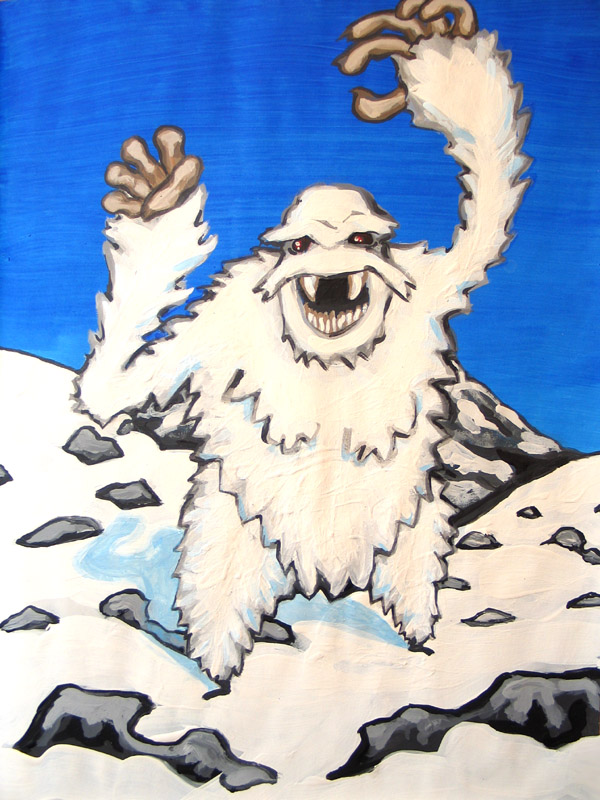
The Littlefoot is a white-haired carnivorous mountain ape indigenous to the Himalayas. Like the North American Sasquatch, this animal is an evolutionary descendant of Gigantopithecus -- a 9-foot-tall ape that lived as recently as 100 thousand years ago in China, India, and Viet Nam. At 12 feet tall, the Littlefoot now claims the title for largest ape ever to have walked the Earth.

Despite living in the same region, the Littlefoot bears no relationship to the mythical Yeti. Whereas notable primatologists such Jane Goodall have been convinced that Sasquatch exists, there is a consensus among serious scientists that the Yeti is a product of folklore and hoaxers.

However, that said, there are some important distinctions that must be made. "Yeti" is a catch-all moniker for several supposed animals, which include the Meh-Teh (the "classic" Yeti), the Teh-Lma (a three-foot-tall frog-eating Yeti), and the Dzu-Teh (a giant half-bear, half-ape creature, which walks on all fours). When people discuss the Yeti, it is almost exclusively the Meh-Teh that receives their attention.

My own research confirms that the Meh-Teh is most likely a product of the imagination... But the Dzu-Teh is quite real. It is what the Littlefoot eats.

The Littlefoot has several interesting adaptations that have preserved its anonymity for so long -- leading some to say that the beast is actually unfilmable.

First of all, there are its feet. In stark contrast with the Littlefoot's huge body, it has tiny little flat feet -- which make footprints easily mistaken for those made by a human wearing shoes.

Secondly, the animal lives in deep ice caverns, and only comes out to hunt during severe, near-blinding blizzards. Thus, eye-witness sightings are profoundly unlikely -- and the winds quickly obliterate the already misleading tracks that it leaves behind.

Thirdly, the Littlefoot is an extremely fastidious creature. When it kills its prey, nothing is left behind. It is careful to bring every bit of the Dzu-Teh carcass back to its lair. I have been lucky enough to get a glimpse of the ancestral caverns -- which after so many years, are now like bone cathedrals, meticulously decorated with thousands of old skeletons.

My having finally been able to track down a Littlefoot tribe's cave is almost entirely thanks to another man's misfortune. Three years ago, a fellow cryptozoologist became lost during a blizzard on Mount Shishapangma. He was tracking a Dzu-Teh -- but little did he know that a Littlefoot was just behind him, following the same trail. Camera in hand, he was about to photograph his "Yeti" -- when the Littlefoot struck...

But, just at that moment, an avalanche came tumbling down the mountain and took the lives of all three! Neither the researcher, the Dzu-Teh, nor the Littlefoot were ever found -- but miraculously the camera survived intact.

The story of how the camera came into the hands of the Chinese authorities, got smuggled out of the country, and then found its way to me -- is too involved to tell here. However, I would be remiss not to mention that there is a small movement afoot to rename the Littlefoot after the researcher who died discovering it: "Mullins' Yeti."

Despite my protests that the Littlefoot is an unrelated species, I expect sentimentality will win out and the name will stick.

Saturday, October 13, 2007

K - The King Shielyana


[click to enlarge]


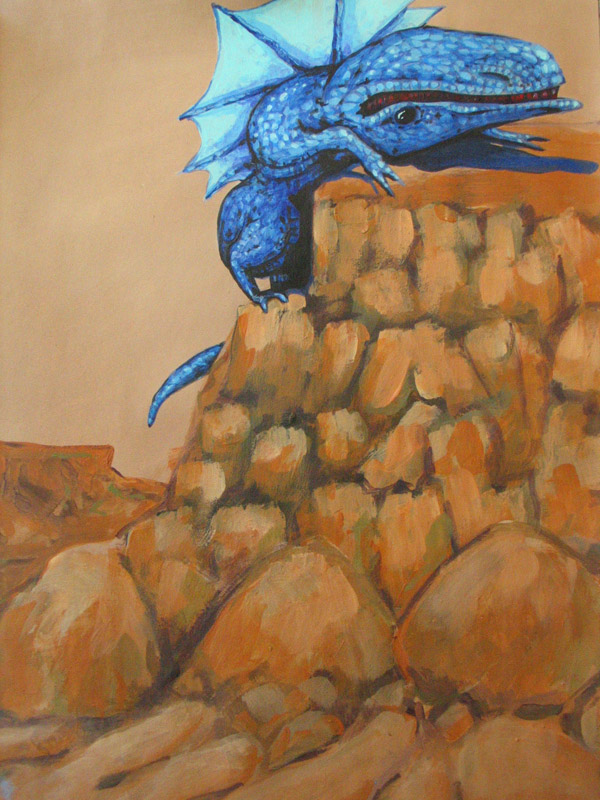
There are several varieties of Shielyana, including: the Dwarf Shielyana, Zompire Shielyana, Emerald Shielyana, and King Shielyana. Of these, the King Shielyana is the largest and most majestic -- being approximately 50 feet long and covered with shining sapphire-blue scales.

Shielyanas are essentially a form of land whale. All cetaceans (whales, dolphins, and porpoises) are descendants of land-living mammals; Shielyana aside, their closest living relative is the Hippopotamus. In a moment of evolutionary indecision, after having returned to the oceans where all life began, Shielyanas decided that life on land really was better after all. Going from one extreme to the other, the Shielyana's aquatic forebears moved as far inland as possible and became desert dwellers.

The King Shielyana is native to the Sonoran Desert, with the majority of specimens being found within Arizona's state borders. Whereas most desert animals find shade during the hottest part of the day, the Shielyana thrives in the heat, and seeks out all-bright locations. The animal regulates internal temperature by raising or lowering its webbed dorsal fan.

Instead of teeth, the King Shielyana has baleen plates growing from its upper jaw, which allow filter-feeding. The animal's diet consists primarily of pollen and air-borne desert krill.

Shielyanas lead a solitary existence until it comes time to mate. Once they have a found a suitable partner, they spend the rest of their life traveling as a pair. The animal typically bear two young per litter.

Friday, October 12, 2007

J - The Jrumiglior


[click to enlarge]


The Jrumiglior is unique in the literal sense: only one such animal currently exists on Earth.

It is non-terrestrial in origin, having come to our planet in a meteor approximately 400 million years ago. It is not, however, independently space-faring. Evidence suggests that it was sent here by a second species, as part of a colonization effort.

***


The Jrumiglior exists in two distinct states: dormancy and activation.

In its dormant state, the animal becomes utterly rigid and its color turns to a slate gray. It is easily mistaken for a surreal stone statue.

Activation is triggered by extreme heat (in excess of 300°F). When the Jrumiglior's environment reaches this temperature, its blood / internal fluids re-liquify, and normal metabolic functions resume.

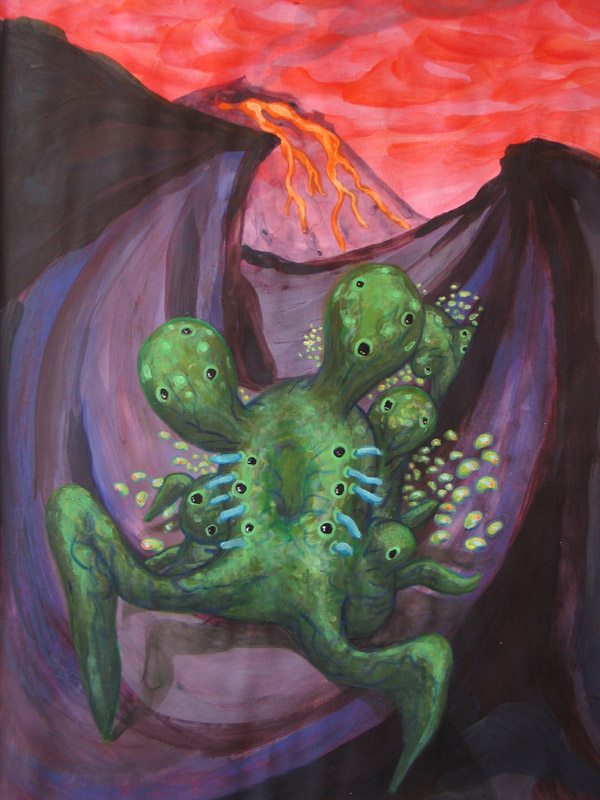
When dormant, the animal is frozen in a curled up position -- much like a pill bug -- and it is approximately the size of a small car. When activated, it unfurls itself, revealing a form 30 feet in length that is simultaneously reminiscent of a centipede and a prickly pear cactus.

The Jrumiglior has a segmented body. There are ten segments, each with two pointed legs. Internal partitions allow any one segment to be severed from the whole and still continue functioning independently.

Like yeast, the Jrumiglior reproduces by budding. At any particular time, each of the body's segments is likely to have between one and three new "bulbs" growing off of it. The animal is so long-lived, it is essentially immortal. Bulbs develop slowly; there is no record of one breaking off from the main body during its time thus far on Earth. (Given how infrequently the animal has been activated, however, this does not really tell us very much.)

In its activated state, the skin is green, wrinkled, and warty -- rather like a pickled gherkin. Blue vein-like structures are visible beneath the skin. Some of these break through the surface and develop into prehensile tongue-like organs. The creature's dorsal surface is punctuated with beady, jet-black eyes. These begin as cysts, which over time move outward, ultimately erupting through the derma in a largely random pattern.

***


Much of what we know about this animal's existence -- both on Earth and before coming to Earth -- has been pieced together from archaeology and occult tomes.

The earliest known images of it come from ancient texts that were discovered in Australia. The Jrumiglior appears several times in fragmentary writings attributed to a great race of conical beings, which voluntarily departed from our planet prior to the emergence of dinosaurs.

Images of the Jrumiglior appear again in hieroglyphics that date back to the Triassic Era, which were recovered in the 1930s from a deep, hidden cave in Antarctica. It appears that the creature was kept there in suspended animation for nearly 250 million years. The broken doors of its vault warn of dire consequences for those who would awake the beast. What sort of beings served as guardians, watching over the Jrumiglior for so long? As of yet, science has no satisfactory answer.

It is unclear how the Jrumiglior came into human hands. However, it has been nothing but a curse to those who have tried to possess it. My colleague, Professor Albert A. Zeef, has made an in-depth study of this history -- which I shall only briefly synopsize here...

For at least a thousand years, the dormant beast seems to have been kept in a hidden underground city in England -- whose strange inhabitants ultimately degenerated into cannibalism. From there, the beast was forcibly taken by a certain pre-Christian religious sect, which transported it to the USA -- carrying it underwater through the Atlantic with the aide of a peculiar, blob-like aquatic creature which I am personally unfamiliar with. The Jrumiglior came to reside in a small fishing town in Massachussets, where -- over generations -- the townsfolk have lost their humanity, due to interbreeding with a species distantly related to the Forg.

The last definite location of the Jrumiglior was in New England. A renowned "wizard" stole the beast from the misceginated forg/humans, and concealed it beneath his farmhouse dwelling. Due to an unrelated tragedy, the estate burned down -- and during the fire the animal was temporarily reawakened. This is where the historical record ends.

***


The Jrumiglior's current location is uncertain -- but humankind has reason to be fearful. Recent re-interpretations of the Australian texts have shed new light on the creature's distant origins -- and its possible future.

References are made to an unknown species living outside of our solar system. Their name, roughly translated: "The Contributors." Apparently Contributors use the Jrumiglior as a midwife to their own young. The beast is mechanically split open and thousands of fertilized eggs are implanted in its central body cavity. The Contributors telepathically imprint programming into the Jrumiglior's nervous system, and then send it out through space to colonize other planets. When the programming is triggered, the animal deposits the Contributors' eggs in their new habitat. Certain secretions from its body jump-start the maturation process, and soon the eggs begin to hatch. Thus, the Jrumiglior serves first as a protective vessel for Contributor eggs -- and then later, when the eggs are exposed and vulnerable, as a ferocious guardian.

From what we can decipher, the trigger which causes the Jrumiglior to deposit the eggs is some sort of alignment of the stars.

During the past year there have been rumors of the Jrumiglior being sighted awake and active near Mt. Etna -- an Italian volcano which is currently erupting. My contacts report that a large centipede-like creature has been spotted emerging from freshly hewn lava tubes... And that it has been seen on the horizon against a sky of fire, looking up -- as if waiting expectantly for some sign.

I for one am profoundly disturbed by the implications. If this creature is indeed the Jrumiglior and it finally enacts its intended purpose, then the extinction of native life on Earth may very soon come to pass.

Yet, there is hope. I have alerted a secret society whose very purpose is to find and contain the "Apocalypse Wurm." Let us pray for their success.

Thursday, October 11, 2007

I - The Ichabod


[click to enlarge]


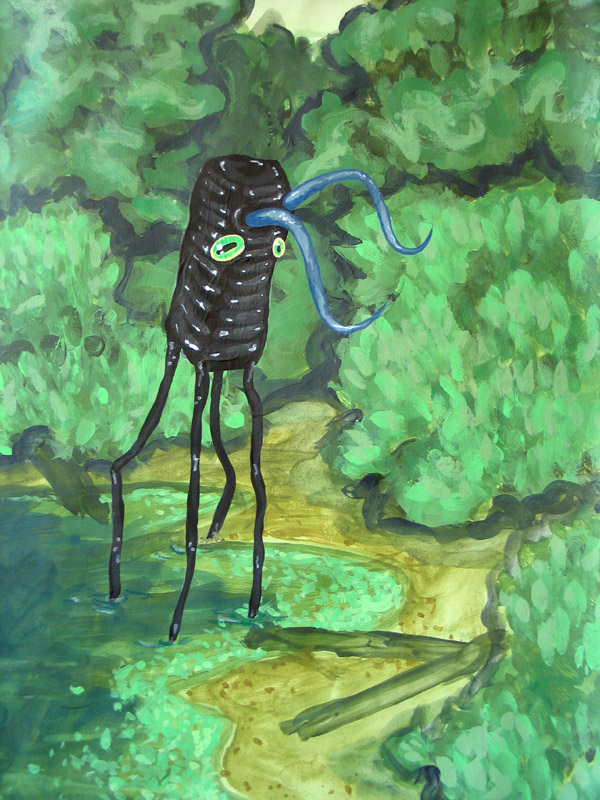
The Ichabod is found only in the deep swamps of Louisiana. Its diet consists solely of Polycephalic Forg-men. Once on the very brink of extinction, there is currently a resurgence in the Ichabod population. Hurricane Katrina helped re-sediment the Forg-men's habitat -- leading to larger than usual clutches of heads. With more prey available, there is hope that Ichabods may yet be able to reestablish themselves.

The adult Ichabod stands approximately seven feet tall. It has long, spindly legs that help it travel more easily through algae-clogged ponds. The legs have neither a skeleton nor exoskeleton; rather, they function purely through vascular tension. The body is boxish, and has roughly the proportions of a milk carton. Two long, prehensile tongues are used for capturing Forg-men. Its pie-plate sized green eyes have slit-like irises. The animal's skin is shiny-black with horizontal ridging, and exudes a thin, clear slime at all times.

The evolutionary origins of the Ichabod species remain somewhat mysterious. Our current best guess is that the creature is a zorn created long ago by a virus that no longer exists. [For an explanation of the term "zorn," please refer to my previous post about the Elysian Zorn.]

The "Insect-Amphibian Transmission" theory proposed by Professor Julian Roche suggests that the Ichabod might even be the result of two successive zorn transformations. The basic idea is that the first virus was associated with a variety of Black Slime Mold. It corrupted the genetic code of an insect related to the Walking Stick. Some time after this, the virus mutated again and was passed on to salamanders -- which ultimately became the Ichabod of today. DNA sequencing for zorns is notoriously difficult -- but Roche's preliminary results do lend some support to this explanation.

The Ichabod takes its name from the fictional character "Ichabod Crane" in Washington Irving's short story, "The Legend of Sleepy Hollow." To understand this, however, first a few words must be said about the life cycle of Polycephalic Forg-men.

The Polycephalic Forg-man is continuously growing and shedding new heads during the course of its lifetime. Heads that have been shed are often left in clutches like eggs, where they develop into new, full-bodied animals. The Ichabod survives by eating these heads.

Previously, while working on an unrelated project, Mr. Bonnichsen created a reasonably accurate illustration of the Polycephalic Forg-man. I have reproduced that drawing here with his permission.


The Polycephalic Forg-Man


When attacked by a predator, Forg-men are able to shed their current head as a defensive measure. With luck, the predator will be distracted -- chasing after the headless body, which scrambles off wildly. The severed head will ultimately grow a new body; but without a head, the decoy body dies in convulsions several hours later.

This defense is particularly effective against the Ichabod, which by all appearances is horrified by the headless body. Invariably, it runs away, trying to escape the thing... Much like Ichabod Crane fleeing in terror from the Headless Horseman in Irving's famous tale.

Wednesday, October 10, 2007

From Sumatra: The Porpische


[click to enlarge]


The Porpische is an extremeophile: it lives in deep ocean crevasses, where immense pressures and volcanic heat vents make human exploration extremely difficult. Populations have been discovered off the eastern coast of Sumatra. Whether the species exists in other areas is not yet known.

The Porpische is large -- nearly twelve feet in length. With a long "bottle-nose," the animal looks somewhat like a dolphin. However, it is actually a form of fish -- with gills and a cartilaginous skeleton -- distantly related to sharks.

Porpische have a beautiful full-body bioluminescence. The entire animal glows with a ghostly pink light. When the animal is startled, the light suddenly winks out -- presumably to help hide it from predators. (What sort of deep-water leviathan hunts Porpische is currently a mystery.)

Rather than fins, the Porpische has two bat-like wings at its sides. The impression that the animal is actually "flying" through the water is astonishing. Like a bird that rides updrafts of warm air, it can use these wings to catch an updraft of hot water coming from a volcanic vent and soar swiftly upward. One can imagine that this ability occasionally provides the animal with a means of quick escape when it finds itself in danger.

Porpische seldom come up farther than the mouth of the chasms in which they live. Watching the glowing beasts gently circling back down into blackness, like a spiral of Christmas lights disappearing into the night, one's mind cannot help but be tattooed with a haunting sense of wonder. Myself, I count this experience as one of the most awe-inspiring moments of my life to date.